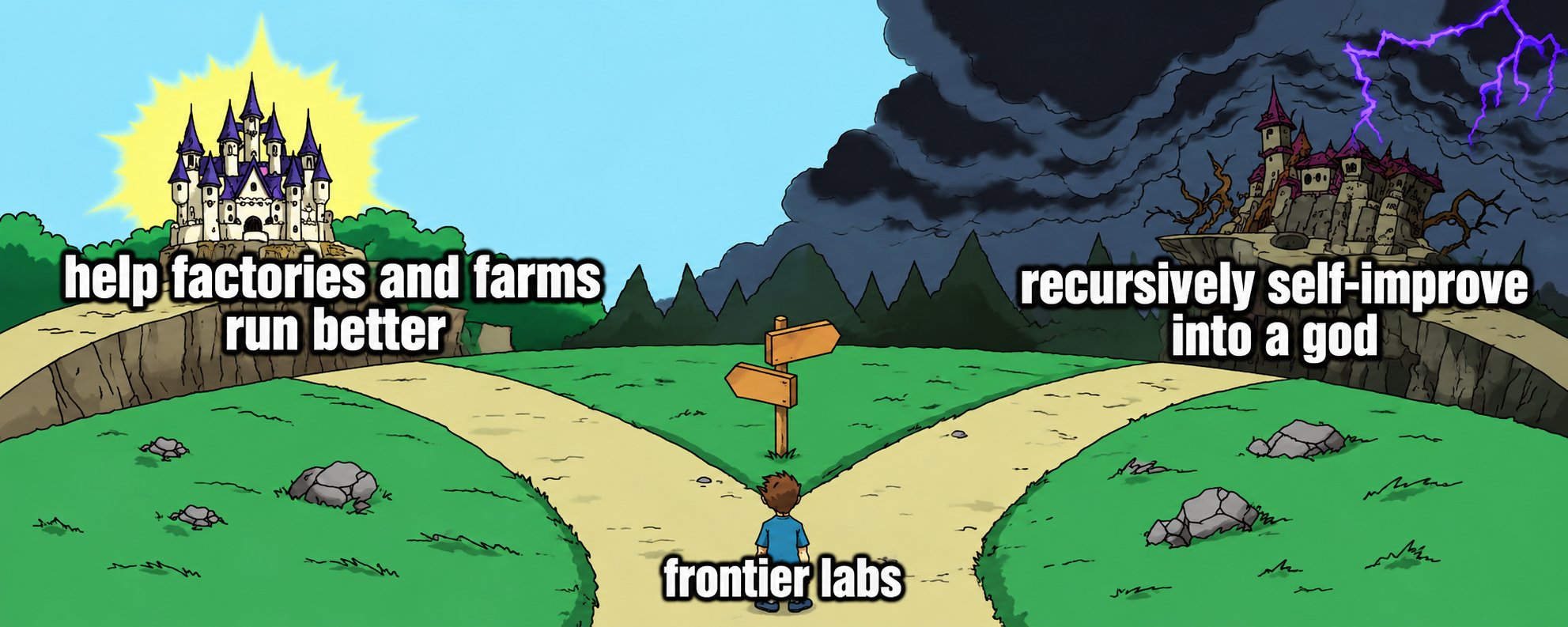
Tl;dr: I think frontier labs can make trillions of dollars a year without needing to cure cancer or replace white collar work. Instead, they can build a Universal Basic Management Consultant for the developing world.
I'm somewhat skeptical that current research is on the path to "real" AGI or meaningful RSI. Let's suppose I’m right that models continue being superhuman at familiar work, but someone still has to define objectives and inject judgment when things get out of domain. Indeed, I expect AI to stay pretty bad at most marginally valuable "unbounded" tasks. So does that mean the frontier labs screwed? I don’t think so. Though they might have to touch more grass.
Rather than asking how we can use AI to do new things, it may be more tractable to look abroad where we need AI to help people do basic things a little bit better. This seems like a pretty good match for the technology we have today. Give a model enough context about a familiar problem and it can be extraordinarily useful. The world has a lot of familiar problems. Most things that most people do on any given day are repeating best practices.
Let's look at results we've already seen. In one experiment with Indian textile firms, consultants helped implement basic management practices and boosted productivity by 17% in the first year. This involved things like tracking defects and managing inventory. No scientific breakthrough required. [1] In a Nigerian farming trial, researchers found that personalized rice-growing advice increased yields about 7%, without increasing total fertilizer use. The advice merely accounted for local conditions instead of giving everyone the same instructions. [2]
Neither experiment used modern AI. They show that there’s lots of value in helping people apply existing knowledge. My bet is simple: AI can provide a Universal Basic Management Consultant for all and that will drive breathtaking catch-up growth for the rest of the world. What's the potential impact? A pretty crazy number. Today, 6.8 billion people live in low to middle income countries and generate $41 T in annual GDP. If you bring their output up to today’s high-income average, roughly $54,000, you get $326 trillion in additional annual GDP.
FULL CATCH-UP: +$326T/YEAR IN WORLD OUTPUT

World GDP today
|=========| $118T/year

Everyone at today's high-income GDP per person
|=========|+++++++++++++++++++++++++| $444T/year
           <---- +$326T/year ------->
How much of this can AI labs capture? Let's start with the economics of existing deployments. A Google study modeled $1.62 million in spending for $13.4 million in benefits: about 12% of the gains captured. A Microsoft industrial AI study puts the central estimate at 25%. That implies $39 to 83 trillion per year in deployment spending when applied to the 326 T per year catch-up gap. That includes software, infrastructure, integration and training. Of course, the labs can and will sell more than tokens. [4] [5]
Obviously this takes more than handing a factory owner a ChatGPT subscription. Someone needs to collect the local data, understand what’s going wrong, and help people change what they do. A lot of the data is physical or interpersonal, and you need to see the impact of interventions. This works if each deployment requires less expert time than the last, but hillclimbing benchmarks seems to suggest this sort of thing is possible. And once you’re doing it across thousands of factories or farms, there should be a lot of useful experience to share.
Of course, poverty has plenty of causes that a model can’t immediately solve, but many of them boil down to coordination problems and trust. A really smart Claude or ChatGPT-shaped friend is the perfect wedge to coordinate billions of people. It can give suggestions on how to better use existing resources. It can help coordinate suppliers, transport, maintenance, and investment.
I’m skeptical that the current paradigm of AI systems can independently invent their way out of problems on our edge of understanding. I’m much less skeptical that they can help billions of people do things humanity has already figured out.
[1] Indian textile management experiment
[2] RiceAdvice randomized trial